
Preschool Learning Printables: A Parent-Friendly Guide to Choosing the Right Activities
The best preschool learning printables aren’t necessarily the ones with the most pages. They’re the ones your child is willing to try. To find a good...
The best preschool learning printables aren’t necessarily the ones with the most pages. They’re the ones your child is willing to try. To find a good fit, start with an activity that feels inviting and easy to begin. A page can be too challenging, too simple, or simply unrelated to what interests your child.
You don’t need a complicated plan to make practice worthwhile. Choose a printable that connects an interest to one simple activity, such as counting pictures, matching shapes, or coloring a favorite kind of animal. Screen-free, instant-download printables offer a ready-to-use option at home or in the classroom without adding a big preparation task to your day.
This guide compares common printable formats and explains how to match them to your child’s interests, skills, and attention on a given day. You’ll find practical ways to choose between coloring, matching, and early learning activities, along with tips for keeping practice relaxed and playful. We’ll also introduce Luv Printables options, including Little Learners Starter Pack and Smart Start School Skills, as possible starting points.
Key Takeaways
- Preschool learning printables can make early-skill practice hands-on and playful, rather than feeling like another stack of worksheets.
- Compare activity formats by what children do and which skills they invite them to explore.
- Use your child’s interests, the skill you have in mind, the activity’s difficulty, and your available preparation time to guide your choice.
- Keep practice light: offer one page, give a simple prompt, and let your child explore in their own way.
Preschool Learning Printables: What They Offer Beyond a Worksheet
A printable can be more than a page of questions. It’s a paper-based activity that invites a young child to explore by looking, talking, making marks, or choosing between options. A familiar picture or theme gives the child a way into the activity, while a clear task offers a chance to practise an early skill.
Printables differ from digital games, where children interact with content on a device, and physical workbooks, which are bound and ready to use. Each format can suit a different moment. A game may fit a screen-based activity, while a workbook keeps several pages together. With a printable, an adult can select and print a page for a particular activity. Choose based on what interests the child, the skill you want to explore, and what feels manageable right now.
Preschool activities can introduce early skills through playful exploration or short, focused practice. For a broad overview of preschool terminology and approaches, see What is a Preschool? Treat a page as an invitation, not a test. A child might point, talk, color, or simply notice something new.
What skills can preschool printables support?
Different activity styles invite practice across early learning areas. A letter page might encourage a child to spot a familiar shape or listen for the first sound in a word. Picture prompts can build vocabulary as children name what they see and describe it in their own words.
For early numeracy, a page might invite a child to count pictured objects, sort items by a feature, compare groups, or find shapes. Tracing, coloring, drawing, and connecting matching items give children a chance to guide a pencil or crayon. These are examples of what activities can encourage, not a checklist every child needs to complete. Choose a task that suits the moment and leave room for curiosity.
How can printables keep learning screen-free and simple?
Once printed, an activity gives children a hands-on alternative to a device. They can mark, point, circle, or talk about what they notice on paper. Keep the start simple by offering one focused page and a few basic materials, rather than laying out a large stack of choices. Luv Printables’ activities are designed for screen-free use at home or in classrooms, with no preparation needed.
A useful printable gives a child one inviting way to practise, explore, and show what they notice. Offer a simple prompt, such as “What do you see?” Then let the child respond by talking, pointing, or drawing. The page can guide the activity without dictating exactly how it should unfold.
Five Preschool Printable Formats to Match Different Learning Goals
Similar-looking pages can invite different kinds of practice. One asks a child to guide a pencil; another encourages careful looking, counting, or creative choices. Use this comparison to match preschool learning printables to a goal, your child’s preferred way to join in, and the amount of adult setup that suits the moment.
Format | Learning purpose | Child action | Adult setup
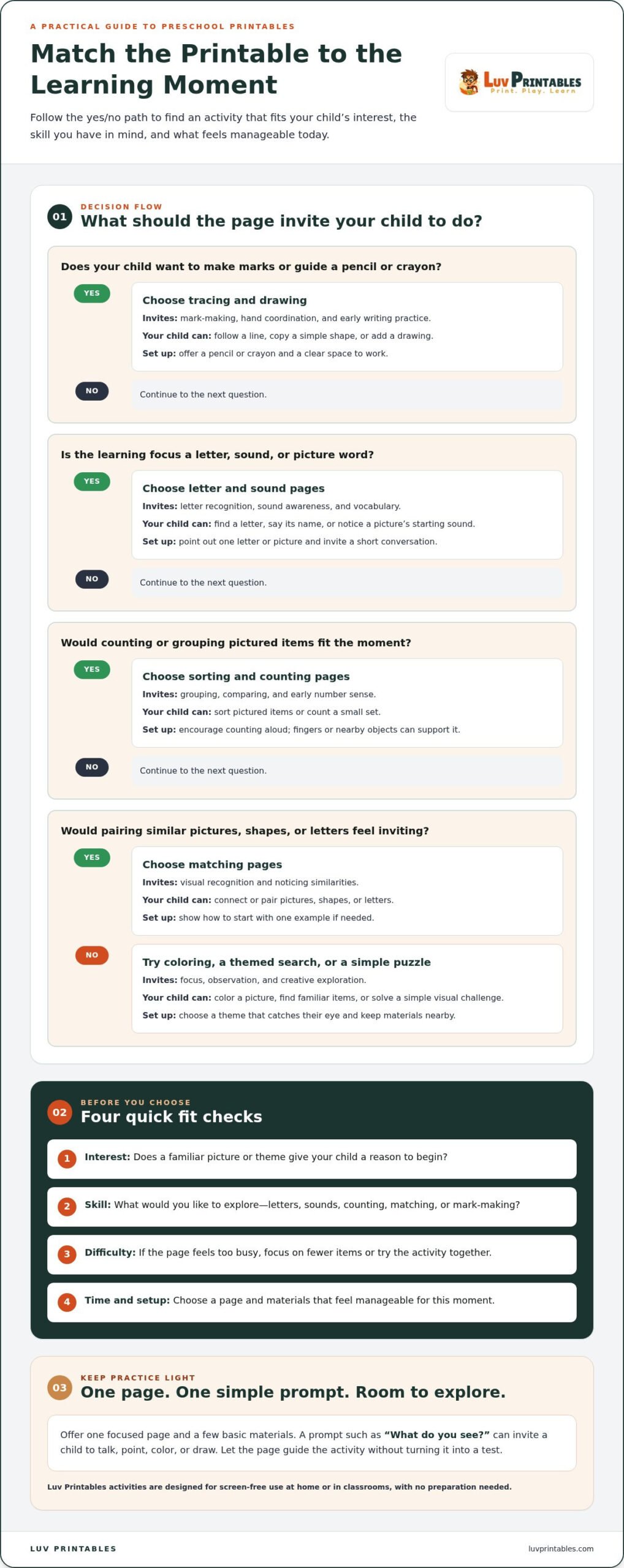
Tracing and drawing | Mark-making, hand coordination, and early writing practice | Follow a line, copy a simple shape, or add a drawing | Offer a pencil or crayon and a clear space to work
Letter and sound pages | Letter recognition, sound awareness, and vocabulary | Find a letter, say its name, or notice a picture’s starting sound | Point out one letter or picture and invite a short conversation
Matching pages | Visual recognition and noticing similarities | Connect or pair pictures, shapes, or letters | Show how to start with one example if needed
Sorting and counting pages | Grouping, comparing, and early number sense | Sort pictured items or count a small set | Encourage counting aloud; use fingers or nearby objects to support it
Coloring, themed searches, and simple puzzles | Focus, observation, and creative exploration | Color a picture, find familiar items, or solve a simple visual challenge | Choose a theme that catches the child’s eye and keep materials nearby
Which printable formats suit early literacy and number practice?
For early literacy, use letter and sound pages as a brief, playful invitation: spot a letter, say a sound, or name a picture together. There’s no need to turn the page into a quiz. A themed word search can also encourage children to look closely for familiar letters or pictures. Explore word search puzzles for kids for another way to bring search-and-find fun into an activity.
For number practice, counting and matching make ideas visible. A child can count pictured apples, then match a group to a numeral or pair objects that look alike. If the page feels too busy, focus on fewer items or try the activity together.
When do coloring and themed activities make sense?
A familiar subject, such as cats, trucks, or space, can give a child a reason to begin. Coloring leaves room for personal choices, so the goal doesn’t have to be staying inside the lines or making a picture look a certain way. Searches and simple puzzles offer more direction while still feeling playful.
Let the child’s mood guide the format. Choose tracing when they’re ready to focus, or coloring when they want more freedom. For a low-prep starting point, browse ready-to-use printable activities and choose a page that suits your child’s interests and the learning moment.
How to Compare Preschool Learning Printables Before You Choose
A large library can turn a quick activity search into one more decision. Make it easier with a four-part check: child interest, intended skill, activity difficulty, and setup effort. Start with something your child enjoys, decide what you hope to explore, then check that the task feels approachable and practical for the time you have.
- Child interest: Does the subject catch your child’s attention?
- Intended skill: Is the activity connected to one clear, simple goal?
- Activity difficulty: Can your child understand how to begin?
- Setup effort: Can you get it ready without adding stress?
Use the four checks as a quick rule: Choose a page your child cares about, that practises one useful skill, feels possible to start, and is easy for you to prepare. This keeps preschool learning printables focused without asking you to compare every option in a catalogue.
How do you match an activity to a child’s readiness?
Age can be a rough starting point, but it doesn’t tell you everything about a child’s interests, experience, or comfort with a task. Look at the first instruction. Can your child begin with a little explanation or by watching you try one example? If so, the activity may be a good fit. If it feels confusing, offer a small hint, simplify the task, or choose another page.
Pay attention to the child, not just the finished page. A pause, a change of direction, or a request for help can be a cue to offer support or stop for now. Participation and curiosity matter more than completing every part perfectly.
What makes a printable convenient for adults?
Check that the page is clear enough to understand at a glance and suits the time and space available. A short activity at home may call for one simple page; a classroom activity may need a format children can approach with minimal explanation. Consider what you’ll need to gather, too. A page that requires several extra materials may not be the easiest choice when time is tight.
Free libraries can offer variety, but browsing a large collection may take time. Editable templates let adults adjust a resource, though making changes adds a step. A ready-to-print download offers a direct way to choose and print an activity without customizing it. Luv Printables offers instant-download activities designed for screen-free use at home or in classrooms, with no preparation needed. Explore instant-download printable activities for a ready-to-use option.
How to Use Preschool Printables for Calm, Playful Practice
A printable doesn’t need to fill a whole afternoon to make a learning moment worthwhile. Keep the plan simple and responsive. Choose one page that suits your child’s interest and energy, then let the activity unfold at an easy pace.
- Choose one page. Pick an activity with a clear starting point and a theme your child is likely to notice.
- Gather basic materials. Set out what the page calls for, such as a pencil or crayons, so you’re not searching once you begin.
- Invite exploration. Offer a gentle prompt, then let your child point, talk, draw, or try the activity in their own way.
- Wrap up positively. Notice a choice, question, or small discovery, and stop while the moment still feels comfortable.
That’s enough. Preschool learning printables can support a relaxed routine without turning practice into a performance. If interest starts to fade, pause, make the task smaller, or switch activities. You can return another day; there’s no need to push through every part of a page.
How can adults support without taking over?
Try open prompts like “What do you notice?” or “Which part would you like to try?” If the instructions seem tricky, explain them in a few words or demonstrate one small step. Then give the child room to make their own choices and marks. Celebrate effort, questions, and discoveries, not only correct answers or a finished page.
How can one printable fit home or classroom use?
The same page can work differently depending on the setting. At home, an adult might sit beside one child and follow their pace. In a classroom, children could explore individual pages or look at one together, with the adult guiding a shared conversation. Adjust the support and timing to suit the group. One activity can invite exploration, but it doesn’t guarantee a particular learning outcome.
Let the child’s response shape what happens next. A focused start may turn into a story about the pictures, a new way of using the page, or a quick finish followed by something else. Each can be a pleasant stopping point. The aim is a warm, manageable experience, not a perfectly completed worksheet.
For an easy next activity, browse Luv Printables activities and choose a ready-to-print option that fits your child’s interest and the moment.
Explore Luv Printables for Ready-to-Use Preschool Learning
Once you have a sense of the activity style that suits your child, choosing a resource can feel simpler. Luv Printables offers instant-download activities designed for screen-free use at home or in classrooms. They’re made to be printed and used without preparation, giving adults a practical way to bring an offline activity into a learning moment.
Keep your selection grounded in three things: what catches your child’s interest, what feels useful right now, and how much setup fits your day. If your child is drawn to a particular theme, let that guide your search. If you have only a short window, choose an activity that feels straightforward to begin. The right page is one that feels like a cheerful fit, not another task to manage.
Which Luv Printables options can readers explore?
Two options to explore are Little Learners Starter Pack and Smart Start School Skills, both printable activity products from Luv Printables. To choose a starting point, consider which option seems to suit your child and the learning moment. Then let your child’s interest guide how you use the activity.
What makes instant-download printables easy to start?
These digital products are available as instant downloads for printing, rather than as physical activity books shipped to your home. Their screen-free format lets children engage with printed activities away from a device. Luv Printables’ activities require no preparation, helping adults keep the lead-in simple and the focus on the child’s experience.
After choosing an activity, print it, gather any basic materials it calls for, and offer it when your child is ready to explore. You don’t need to turn a printable into a full lesson or expect a particular result from one sitting. A few minutes of looking, talking, or trying can be a good place to begin. If the activity doesn’t hold your child’s attention, save it for another moment and choose a different fit next time.
Preschool learning printables work best as flexible invitations to explore, not a fixed plan every child must follow. Let interest lead, keep the learning moment in mind, and choose an option that feels manageable for you. Explore Luv Printables activities to find a ready-to-print option for your next screen-free learning moment.
Make Room for One Small Learning Moment
Let the next activity grow from something your child already enjoys. A favorite animal, a curious question, or a picture they keep talking about can spark a fresh moment of discovery. You don’t need to turn that interest into a big plan. Follow their lead and leave room for conversation, imagination, and a little trial and error.
That’s the heart of using preschool learning printables: offer a gentle starting point, then let your child’s curiosity shape what happens next. Some days, they may want to linger. Other days, a quick look is plenty. Both can make space for connection and joyful practice.
Ready to find an activity for your child’s next curious moment? Explore Luv Printables and find a cheerful activity to start today. Keep it simple and enjoy the little discoveries.
Frequently Asked Questions
Are preschool learning printables useful for early learning?
Yes, preschool learning printables can give children a playful way to explore early skills. For example, after reading a picture book, invite your child to find a letter on a page or draw a picture from the story. Keep the activity connected to something familiar and let the conversation wander. A few curious observations can make the moment worthwhile; there’s no need to finish a stack of pages.
What should preschool printables include?
A useful printable has a clear task, a simple purpose, and room for a child to participate with suitable adult support. Before offering it, look at the page together and explain any unfamiliar picture or direction. If the activity involves sorting, for instance, show how two items share a feature. One clear idea can be easier to enjoy than a page trying to practise several things at once.
How do I choose preschool learning printables for my child?
Choose preschool learning printables by connecting the activity to something happening in your child’s day. If they’re curious about the weather, a page with clouds or sunshine may feel more inviting than an unrelated task. Notice whether they can start after a brief explanation, then stay nearby if they need help. If their attention shifts, save the page for later or try a shorter, simpler activity.
Can preschool learning printables be used in a classroom?
Yes, printables can suit classroom activities as well as home use. An educator might offer the same page to children individually, then invite anyone who wants to share a detail they noticed. For a group with varied interests, children can describe their choices rather than produce matching results. Keep instructions brief and adjust the pace to the room, so the page supports participation without requiring every child to work in the same way.
Are printable worksheets better than educational apps for preschoolers?
Neither format is automatically best; each suits different moments. A printable can be helpful when you’d like children to make marks, point to pictures, or talk with someone nearby. An educational app may suit a time when a digital activity is the preferred option. Think about the kind of interaction you want and what your child is drawn to that day. Switching formats across different moments is perfectly reasonable.
Do I need special supplies to use preschool printables?
Usually, you can begin with the printed page and a basic item such as a pencil or crayon, depending on the activity. Look over the page first so you can gather anything it calls for before inviting your child to join. Luv Printables’ digital activities are ready to print and require no preparation, making them easy to fit into a simple home or classroom routine.
What is the difference between a printable worksheet and an editable template?
A printable worksheet is generally intended to be used as it appears once printed. An editable template lets an adult change parts of the design before printing, which can help tailor wording or appearance but adds a customization step. If you want to get started with less decision-making, choose a page that already suits the activity you have in mind. If adapting the layout matters, a template may offer more flexibility.