

Printable Worksheets for Home: Easy Learning Ideas
What if the best worksheet for today isn’t the one with the most questions, but the one your child is happy to start? With so many printable...
What if the best worksheet for today isn’t the one with the most questions, but the one your child is happy to start? With so many printable worksheets for home to choose from, it can be hard to know which page will feel right: not too tricky, too simple, or like another school assignment.
You don’t need a perfect plan or a stack of prepared activities. A short, screen-free activity can fit between breakfast and errands or bring a little calm to a busy afternoon. Choose for your child, the moment, and the time and energy you have today.
This guide shows how to pick approachable worksheets and use them without adding pressure. You’ll find practical ways to match activities to your child’s interests and current comfort level, make them easy to start, and keep the experience light. Ready-to-print options from Luv Printables can make getting started simpler, too.
Key Takeaways
- Choose printable worksheets for home based on your child, the moment, and the time you have.
- Let your child’s interests and confidence guide your choice, using age labels as a starting point rather than a rule.
- Explore early learning, word activities, coloring, and creative prompts to find a format that suits the day.
- Keep setup simple: offer one activity, join in or give your child space, and stop when it feels complete.
- Start small instead of planning a full sequence. One manageable activity can be easier to begin.
What Are Printable Worksheets for Home, and What Can They Add to the Day?
A printable worksheet is a paper-based prompt or activity with a clear next step, such as tracing a shape, finding a word, or drawing an idea. An at-home printable is a small, ready-to-use activity, not a full lesson plan. It can offer a little practice, a creative pause, or something to do together without turning the kitchen table into a classroom.
That flexibility is the point. A worksheet is one option among stories, coloring, puzzles, and hands-on play, not a schedule that needs to fill the day. The study of educational psychology considers how people learn and how learning can be supported. At home, a simple invitation and room for a child to explore at their own pace can be a practical place to start.
What makes a worksheet feel right for home?
Look for directions your child can understand, a task that feels manageable, and enough room to write, draw, or try an answer. A short coloring prompt may suit a quiet break after lunch. If you have a few minutes together, you might sound out a word or talk through a picture. Offer the page without expecting perfect answers or a long session. If your child is ready to stop, the activity has still served its purpose.
What kinds of printable activities can families use?
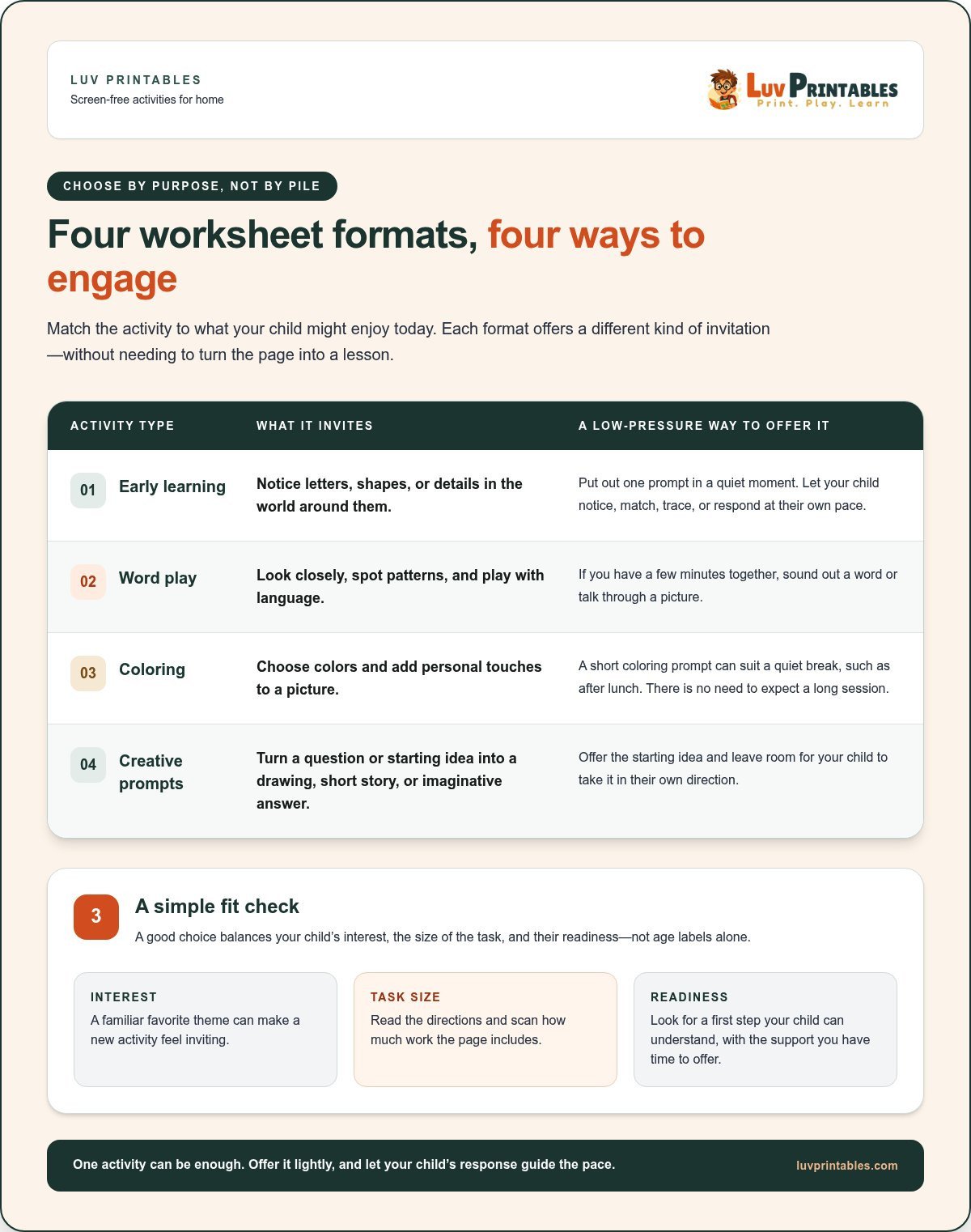
Choose based on the activity your child might enjoy rather than collecting a pile for every subject. A few familiar formats offer different ways to engage:
- Early learning: Simple prompts invite children to notice letters, shapes, or details in their surroundings.
- Word play: Word activities encourage children to look closely, spot patterns, or play with language.
- Coloring: Pictures give children room to choose colors and add personal touches.
- Creative prompts: A question or starting idea can lead to a drawing, a short story, or an imaginative answer.
Luv Printables offers printable worksheets and coloring pages alongside other children’s activities, including the Little Learners Starter Pack. These instant-download, screen-free activities are ready to print for home or classroom use, with no preparation needed. Choose a style that fits your child’s mood, offer it as an invitation, and let the rest of the day carry on naturally.
Choosing the Right Printable Worksheet for Your Child
The best choice isn’t always the page marked for your child’s age or grade. When choosing printable worksheets for home, start with what’s happening now: Is your child eager to draw, ready for a quick win, or settled enough to focus? A good fit balances interest, task size, and readiness rather than relying on age alone.
Use this four-step check before offering a page:
- Notice the moment. Consider your child’s energy and your own. A busy transition calls for something short, while a calm stretch may leave room for more focus.
- Follow your child’s interest. A favorite animal, vehicle, or story theme can make a new activity feel familiar. Interest is an inviting starting point, though it doesn’t guarantee every task will be a hit.
- Choose a manageable task. Read the directions and scan how much work the page includes. Pick something your child can begin with the support you have time to offer, while leaving room for curiosity or effort.
- Offer it lightly. Let your child know the activity is there to try. They can start, ask for help, or pass for now. The invitation doesn’t need to become an assignment.
How can you tell whether a worksheet is a good fit?
Read the directions first and think about what help might be needed. If your child can understand the first step independently, or you can explain it in a few words, the page may be approachable. Look for a task that feels within reach but still holds their attention. If frustration builds, pause, simplify the activity, or save it for another day. That’s useful feedback, not a setback.
How do interests and energy shape the choice?
Match the activity to the mood and time available. A child who wants a quick win may enjoy one clear prompt; a budding storyteller may be ready for an open-ended creative task. Save more focused practice for an unhurried moment. Browsing by subject or grade, as on printable worksheets for various subjects, can help you find options, but your child’s response matters more than a label.
Notice what happens after you offer the page. Does your child lean in, ask a question, or wander away? Their response can guide your next choice. If the task feels too big, find a shorter starting point or offer to do the first part together. If it feels too easy, invite your child to add a drawing, explain an answer, or make up a new challenge. Keep the invitation flexible and let your child’s interest guide the pace.
For a ready-to-print option, browse Luv Printables’ children’s activities, including the Little Learners Starter Pack. Choose an activity that suits the moment, then see how your child responds.
Printable Worksheet Types for Home: Choose by Purpose, Not by Pile
A long list of subjects can make choosing feel like another task. Instead, start with what you want the activity to invite: a little practice, a playful pause, or room to imagine. Different formats can hold a child’s attention in different ways, but none has to deliver a particular result. Treat printable worksheets for home as flexible options, not a checklist to complete.
Activity type | Home-friendly purpose | Low-pressure way to offer it
Early learning prompts | A brief chance to notice, match, trace, or respond | Put out one prompt during a quiet moment and let your child explore at their own pace.
Word activities | A playful way to engage with letters, words, or patterns | Invite your child to look for a word or solve a small part together.
Coloring | An open-ended creative pause | Offer a picture and let your child choose how to fill it in.
Creative worksheets | A starting point for drawing, storytelling, or ideas | Treat the prompt as a spark, not a set of rules to follow.
Use the table as a quick guide, not a ranking. A child may enjoy a clear prompt one day and prefer to make up a story the next. The best format is the one that feels inviting in that moment.
When might an early learning worksheet be useful?
A simple early learning prompt can suit a calm, brief practice moment, such as sitting together before lunch or taking a quiet break. Keep the invitation small: point to one item, read a direction aloud, or let your child decide where to begin. The Little Learners Starter Pack is one printable option for families exploring preschool learning printables.
Notice whether the page feels easy to start. If your child begins with interest, give them space to continue. If they want company, sit nearby and share the first step. The aim is to offer a manageable activity, not to turn a quiet moment into a lesson or measure what your child knows.
When might coloring or word activities be a better fit?
Coloring can offer a relaxed, open-ended pause when a child wants to make choices without one right answer. Word activities may suit a moment of curiosity about letters or words. Try a phrase such as “Want to look for a few together?” and let your child decide whether to continue. This keeps the activity playful and leaves room to stop or switch.
For a child who enjoys spotting letters and playing with words, word activities such as Word Sleuth Fun offer another format to consider. Choose based on the kind of attention or imagination the page invites, not on how many activities you can gather. One well-matched page is plenty for a small moment at home.
How to Make Printable Worksheets Easy to Use at Home
A worksheet routine doesn’t need a lesson plan, a special table, or a perfect stretch of quiet. Keep it simple and repeatable: choose one activity, make it available, decide whether to join in or step back, and finish when it feels complete. A home routine can be short, flexible, and easy to return to.
For printable worksheets for home, try this low-prep flow:
- Pick one activity. Choose a page that suits the moment instead of printing a stack you may not use.
- Make it available. Put the page and only the supplies it needs within reach.
- Choose your role. Explain a direction, sit nearby, or let your child explore independently.
- Finish naturally. Stop when the task feels complete, your child is ready to move on, or the moment has passed.
That’s enough. There’s no need to add a timer, a reward chart, or a sequence of follow-up pages. A familiar spot, such as the kitchen table or a clear corner of the coffee table, can make it easier to begin. Match the setup to the activity: a pencil for a writing prompt, crayons for coloring, or no extra supplies if the page doesn’t need them.
How can you set up a worksheet without extra stress?
Choose a comfortable place and put out the page and basic supplies it calls for. Offer one clear invitation, such as, “This page is here if you’d like to try it,” then give your child time to decide how to begin. There’s no required schedule or session length, and finishing every prompt doesn’t need to be the goal.
Once the page is ready, let your child set the pace. Some children want to hear the directions; others prefer to look first and see what catches their eye. Stay available without hovering. If you’re busy, a short explanation at the start may be all the support they need. An easy start helps the activity fit around family life rather than asking the day to stop for it.
What if your child loses interest or needs help?
Offer a small hint, read a direction aloud, or work through the first prompt together. If the activity stops feeling enjoyable or manageable, pause, switch to something simpler, or put it away for another time. Notice what held your child’s attention, such as a picture, a choice, or a particular prompt, and use that clue to guide a future pick.
Ready-to-print activities make it easy to have a screen-free option at hand. Browse Luv Printables’ printable activities for an activity to try at home.
Start with One Printable Worksheet That Fits Your Home
You don’t need a full plan to make room for an activity. Start with your child, choose for the moment, and keep the first page manageable. A worksheet that matches their interests and energy is easier to offer than a whole sequence of tasks. You can always try another format on a different day.
What can a first worksheet moment look like?
Imagine a quiet stretch after breakfast. Place one suitable page and a pencil or crayons nearby, then ask, “Would you like to try this?” Your child might ask you to join, want a little encouragement, or jump in independently. Follow their lead. The activity can end when the page is done, attention shifts, or the moment naturally passes. It doesn’t need to become a longer lesson.
That small invitation helps you see what feels comfortable. Perhaps your child enjoys choosing colors, wants to talk through a prompt, or prefers to explore on their own. You don’t need to judge the moment by how much of the page gets finished. A few minutes of interest can be enough, especially on a busy day.
How can you keep choosing activities simple?
Afterward, remember one or two details: what your child enjoyed, which part felt easy, or where they wanted help. Use those clues next time. If they liked drawing, try another creative prompt; if they were curious about words, choose a word activity. If the page felt like too much, look for a smaller first step or save it for a calmer moment.
There’s no need to build a collection or decide what comes next in advance. Keep a mental note, or jot down a quick reminder if that helps. Your child’s response is information about what might suit another day, not a score of their ability. A favorite activity can be repeated, while a new format can add variety when your child seems ready.
When you want an easy starting point, Luv Printables offers instant-download activities designed for screen-free use, with no preparation needed. Choose one activity that feels right for your child and your day, then let the moment unfold without pressure. A ready-to-print option makes it easier to begin, while your child’s interests help shape what comes next.
Explore printable activities for children and find one small activity to try at home.
Make Room for a Small Learning Moment
Let the next worksheet moment grow from your child’s curiosity, not a packed plan. A page can be a gentle invitation to explore, create, or spend a few minutes together. Some days it may spark a new interest; on others, your child may simply enjoy a quiet activity. There’s no need to make it bigger than it is.
When you’re ready to choose printable worksheets for home, look for an activity that feels easy to begin and suits the rhythm of your family’s day. Luv Printables offers instant-download, screen-free activities designed for home and classroom use, with no preparation needed. That makes it simple to have a cheerful offline option ready when activity time feels right.
Explore ready-to-print activities for home and choose a page that feels like a good fit for your child. Start small, stay flexible, and enjoy seeing where their curiosity takes them.
Frequently Asked Questions
What are printable worksheets for home?
Printable worksheets for home are downloadable pages children can use on paper for an activity such as drawing, matching, or responding to a prompt. Unlike a complete lesson plan, a worksheet doesn’t set the order for a whole learning session. It can stand alone, fit between everyday routines, or sit alongside a story, game, or conversation.
How do I choose a printable worksheet for my child?
Choose a page that suits your child’s current interest and the support you can offer. If your child is fascinated by animals, for example, a related picture or prompt may feel more inviting than an unfamiliar topic. Read the directions and consider the amount of work before offering it. A clear first step and a familiar topic can make a comfortable place to begin.
Can printable worksheets be used for fun as well as practice?
Yes. A worksheet can be playful, especially when it gives children choices or room to add their own ideas. A drawing prompt might inspire a silly character, while a picture activity can invite a child to invent names or details. Some pages also offer a chance to revisit letters or patterns. Focus on exploring the activity together rather than expecting a particular result.
Are printable worksheets suitable for children at different learning stages?
They can suit children at different stages when the activity matches what each child feels ready to try. The same broad theme can be approached in different ways: one child might point to a picture, while another writes a word or adds a sentence. Offer the page with appropriate support, and adjust the task if it seems confusing or overly simple.
How long should a child spend on a worksheet at home?
There’s no single ideal length. A child might complete one small part and be ready to move on, or stay absorbed longer because the activity feels enjoyable. Watch for signs such as rushing, turning away, or asking to stop. Those cues can help you decide whether to wrap up, offer a short break, or leave the page available to return to later.
What can I do if my child loses interest in a worksheet?
First, consider whether the page feels unclear, repetitive, or simply out of step with your child’s mood. You could read one direction aloud, invite them to choose a favorite part, or set the page aside without making it a problem. If they’re drawn to the topic but not the format, try revisiting that interest through a story, conversation, or hands-on activity another time.
Do I need to plan a lesson before using printable worksheets at home?
No, a formal lesson plan isn’t needed for a one-off activity. It can help to have a simple intention, such as giving your child a quiet option while you prepare a meal, but the page can be offered on its own. Keep any needed materials nearby, explain the starting point if useful, and let the activity fit naturally into the day.