

Word Sleuth Activities for Kids: Playful Printable Ideas
What makes a word puzzle inviting is not how hard it is, but whether it sparks a child’s curiosity. Choosing word sleuth activities for kids can feel...
What makes a word puzzle inviting is not how hard it is, but whether it sparks a child’s curiosity. Choosing word sleuth activities for kids can feel tricky when you want something playful, screen-free, and suited to your child’s confidence and reading stage. A little challenge can be satisfying; too much can make the page feel like homework.
If you need an activity that’s easy to set up and keeps little hands and minds busy, a few simple choices can help. Think about whether the words are familiar, how long the list is, and which directions the words can run. Those details can make a word hunt more approachable for a child who is just noticing letters, while still giving an eager puzzle solver something to explore.
Here, you’ll find practical ways to choose and adapt word sleuth activities, plus simple ideas for using them at home or in class. When you want a puzzle without lengthy preparation, Word Sleuth Fun is a ready-to-print, instant-download option. Print a page, settle in, and let curiosity lead the way.
Key Takeaways
- Turn a word search into a playful investigation by giving the letter hunt a simple mission.
- Make word sleuth activities for kids feel manageable by adjusting word familiarity, list length, and search directions.
- Start with a short list of familiar words to make a first search feel inviting rather than overwhelming.
- Set up a screen-free puzzle moment with a printed page, a pencil, and a cheerful invitation to search.
- Word Sleuth Fun is a ready-to-print, instant-download activity for home or classroom use.
What Are Word Sleuth Activities for Kids?
Word sleuth activities for kids are word searches framed as playful investigations: children scan a letter grid to find and mark each word on a list. The “sleuth” idea gives the search a simple purpose, as if every word is a clue. The puzzle itself is straightforward: look closely, find a listed word, and enjoy each discovery along the way.
A themed word search might feature words about pets, space, or a garden. A shared topic helps give the word list a sense of connection, but it doesn’t automatically make the puzzle a mystery. Some mystery activities use story clues, codes, or hidden-object challenges instead. A word sleuth puzzle is specifically a letter-grid search, even when it’s introduced with a detective-style mission.
What makes a word search feel like a detective game?
A playful premise can turn a quiet search into a small investigation. Invite a child to “track down” the words, inspect the grid for clues, and mark each discovery. Keep the mission simple, such as, “Can you find all the garden words?” No elaborate plot or character is needed. The fun comes from looking closely, finding a word, and seeing the list get checked off.
The familiar format has a word list beside a grid filled with letters. Children search for each listed word, which may appear in different directions depending on the puzzle. The goal is to match a sequence of letters in the grid to a word on the list. For a broader look at the history and mechanics of word search puzzles, Wikipedia outlines how these puzzles work and common ways to solve them.
What can children practise while searching for words?
As children search, they look for letter shapes and patterns, then check whether nearby letters match the word they’re seeking. This repeated looking can encourage visual scanning and careful attention. Spotting familiar words also gives children a chance to recognize written words in a playful setting, without turning the activity into a reading test.
Curiosity is part of the appeal. A child might find a word by noticing its first letter, following a familiar pattern, or scanning a row that catches their eye. Each discovery offers a small moment of satisfaction, and marking the word makes progress visible. There’s no need to rush or get every answer right on the first try. The point is to explore the grid, follow the clues, and enjoy completing the search.
How Word Sleuth Puzzles Turn Letter Hunting Into Play
A word search becomes a playful investigation through a simple loop: choose a word, look for its letters, then mark it when you find it. The child has a clear next step, and the growing set of marked words makes progress easy to see. A detective theme can add a fun mission, but it doesn’t change how the puzzle works.
A word-search grid puzzle has rows and columns of letters, with target words hidden in straight lines. Depending on the puzzle, words may run horizontally, vertically, or diagonally, and sometimes backward. For a beginning solver, a short list of familiar words is a manageable place to start. For example, a child who knows “cat” can look for its first letter, then check whether the next two letters continue in the right order.
- Choose one word. Pick an item from the list rather than searching for everything at once.
- Scan for its first letter. Compare nearby letters with the rest of the word, following a possible line through the grid.
- Mark the find. Trace or circle the letters, then move to another word whenever the child is ready.
How does a child find words in a letter grid?
Start with the first letter of the chosen word. The child can scan the grid for that letter, then follow a possible line and check whether the next letters match. Words may appear in more than one direction, but each puzzle has its own rules. Take a quick look at the instructions before offering a hint, so you don’t accidentally rule out a direction the puzzle uses.
It’s fine to pause and reset. If a promising line doesn’t match, move to another starting letter and try again. This makes the search feel like a series of small discoveries rather than one big task. Adults can invite the child to point to a letter or describe where they’re looking. That keeps the focus on exploring the grid instead of racing to finish.
How can clues make a word sleuth activity more playful?
Offer a tiny verbal clue before naming the target word. For “sun,” you might say, “Look for something bright in the sky.” Then let the child decide whether they want the word or another hint. As they scan, ask what they notice: “Do you see that letter anywhere?” Optional clues add a playful layer without turning the search into a test.
Keep the detective story light. A child can be a word finder, clue spotter, or letter tracker, and the mission can change with each word. These small choices help word sleuth activities for kids feel inviting, even when a search takes patience. Celebrate the discovery, not the speed. For an easy screen-free puzzle to print, browse printable word-search activities like Word Sleuth Fun.
How to Choose a Word Sleuth Activity That Fits Your Child
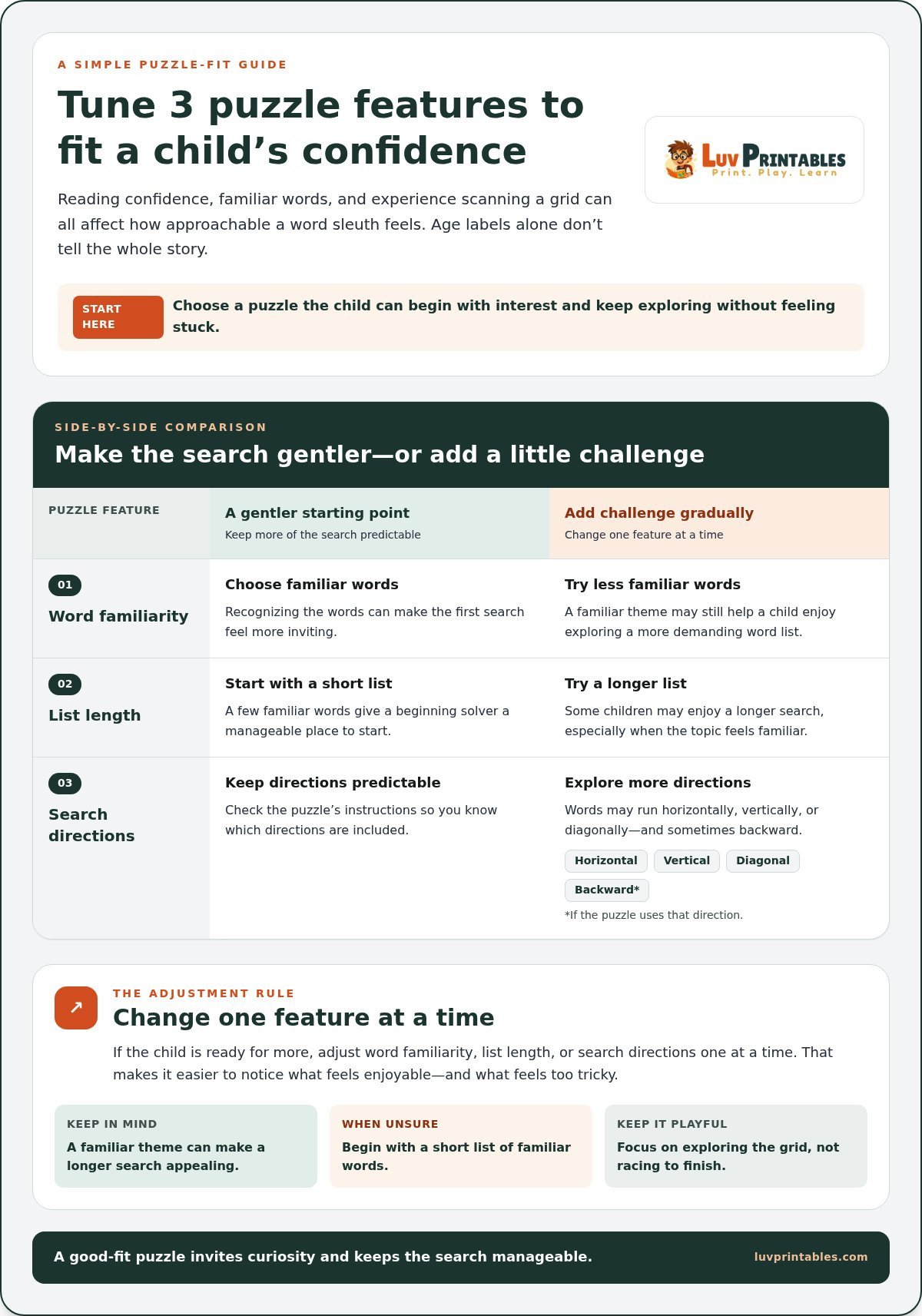
A good-fit puzzle is one a child can begin with interest and keep exploring without feeling stuck. Look beyond age labels: reading confidence, familiarity with the words, and experience scanning a grid all affect how comfortable an activity feels. A child may enjoy a longer search if the theme is familiar, while a shorter list can still feel tricky if the words are new or the directions are less obvious.
Use three puzzle features as a quick guide: word familiarity, list length, and search directions. A gentler version keeps more of the search predictable. To add challenge, change one feature at a time so you can see what feels fun and what feels frustrating.
| Feature | Gentler challenge | Added challenge |
|---|---|---|
| Word familiarity | Words the child recognizes | Some less familiar words |
| List length | A shorter list | A longer list |
| Search directions | Fewer permitted directions | More directions, if included |
These are flexible options, not strict levels. You can also adjust how you approach the puzzle. If a child loses interest, offer a hint or invite them to find one more word before stopping. If they finish quickly and want to continue, try a slightly longer list next time. Following the child’s response helps word sleuth activities for kids stay playful rather than feel like extra work.
Which word-search features make a puzzle easier to start?
For a gentle start, choose a puzzle with a small set of words the child already knows. A clear word list and an easy-to-read grid make it simpler to move between the target and the letters. Stay nearby if they want a hint, but leave room for independent searching. It’s also fine to stop when their interest fades. A puzzle doesn’t need to be finished in one sitting.
How can you add challenge without adding pressure?
Build on what’s working. If familiar words feel easy, introduce a few less familiar ones, or choose a puzzle with additional search directions when its instructions allow them. Avoid changing every feature at once. Otherwise, it can be hard to tell which part made the search tougher. Let the child choose whether to take a small hint, pause for a break, or track down another word.
Age can offer a rough starting point, but it doesn’t tell the whole story. Children gain confidence with letters and word patterns at different paces, and one child may prefer different levels of challenge on different days. Notice the cues: Are they eager to search, asking for help, or ready to move on? Adjust one feature at a time, then follow their response. The aim is a satisfying search, not a perfect score or a race to finish.
How to Set Up a Fun Word Sleuth Activity at Home or in Class
A word hunt can fit into a quiet afternoon, a classroom choice period, or a short break between tasks. Keep the setup light: the puzzle is the activity, so there’s no need to turn it into a craft project. A printed page, a pencil, and an invitation to investigate are enough to begin.
- Print the activity. Have the page ready before inviting your child or group to begin. Read its instructions so you can explain any puzzle-specific directions clearly.
- Set out a pencil. Place it beside the page for circling or marking found words, following the puzzle’s instructions.
- Introduce the mission. Try a prompt such as, “Let’s see what words we can uncover.” Keep the tone playful, not pressuring.
- Invite the search. Let the child choose a word to begin with, or start wherever their eyes land.
What do you need for a ready-to-start puzzle session?
Start with the printed activity and a pencil. Choose a comfortable spot with enough room to see the page, whether that’s a kitchen table, a desk, or a classroom work area. A calm setting can help children focus, but it doesn’t need to be perfectly quiet. Puzzle instructions vary, so follow the directions on the page rather than assuming every word search works in exactly the same way.
In a classroom, the same puzzle can suit different working styles without extra materials. Some children may want to search independently, while others might enjoy comparing finds with a partner if that suits the activity. Introduce the shared mission, then let each child work at a comfortable pace. Offer support as needed, such as reading a listed word aloud or reminding a child to check the puzzle directions, without taking over the search.
How can adults keep the activity relaxed and encouraging?
Notice effort and discoveries, not speed. If a child gets stuck, offer one small clue, such as pointing them back to the word list or suggesting they look for the first letter. Then give them time to search. Too many hints at once can take away the pleasure of spotting a word independently.
Children’s attention can shift, and that’s okay. Let them pause, stretch, or return to the page later if they’d like. In a group, avoid turning the puzzle into a race. Children can find words at different speeds and still enjoy the activity. These gentle choices help word sleuth activities for kids feel welcoming at home and in class.
For a ready-to-print option that keeps setup simple, explore Word Sleuth Fun printables. This instant-download activity is designed for screen-free use, with no preparation needed beyond printing. That leaves more time for the fun part: settling in, following the clues, and celebrating each find.
Try Word Sleuth Fun for an Easy Printable Activity
Once you’ve found a puzzle style that suits your child and have a simple setup in mind, a ready-to-print activity makes it easier to turn a spare moment into screen-free fun. Word Sleuth Fun is Luv Printables’ printable word-search offering. It’s an instant-download digital activity, ready to print, with no preparation needed beyond printing.
That format is handy when a quiet moment appears unexpectedly. There’s no physical activity book to wait for or craft setup to plan. Download the printable, print it, and bring out a pencil. A child can settle into the search at home or use the activity in a classroom, while the adult keeps the setup straightforward.
Why choose a ready-to-print word sleuth activity?
A digital printable gives you quick access to a page to use once it’s printed. It’s a simple option for a calm afternoon, a quiet classroom moment, or a change of pace from another activity. There’s no need to gather craft supplies or build a lesson around it. Follow the puzzle’s directions and let the child begin at a comfortable pace.
Ready-to-print doesn’t mean the activity needs to feel formal. A child can pick a word, search for its letters, and take a break whenever they like. The puzzle provides the focus; your encouragement helps make the experience welcoming.
How can Word Sleuth Fun fit into a child’s day?
At home, bring out a printed page when your child wants something to do away from a screen. It can be a quiet solo activity or a shared search, with an adult nearby to offer a hint if asked. In a classroom, the same printable can provide a simple activity choice without requiring an elaborate lesson plan. Children can work at their own pace, while the teacher offers flexible support.
Choose a moment that feels right. You might keep a printed page nearby for an unhurried afternoon, or use it when a classroom needs a calm, independent task. There’s no need to turn the puzzle into a race or expect every child to finish at once. The aim is an inviting search, a few satisfying discoveries, and a screen-free moment that’s easy to begin.
If you’re looking for word sleuth activities for kids that are simple to prepare, browse Word Sleuth Fun printable word searches. It’s a friendly option for home or classroom use: download the activity, print it, and let the next word hunt begin when it suits your day.
Make the Next Quiet Moment a Word Hunt
The next time your child has a few minutes to spare, let them help shape the moment. Invite them to choose when to begin, how long to search, or what kind of detective they’d like to be. That small choice can make a puzzle feel like their own discovery, rather than another task to finish.
There’s no need to wait for a perfect afternoon or a carefully planned activity. A curious glance at a page can be enough to spark a search, and taking a pause is always fine. Keep the mood light, follow your child’s interest, and let the fun unfold one found word at a time.
For an easy next step, explore Word Sleuth Fun and choose a screen-free activity for home or class. Its printable pages are ready for a quiet moment. With word sleuth activities for kids, a little curiosity can turn an ordinary pause into a cheerful discovery.
Frequently Asked Questions
Is a word sleuth activity the same as a word search?
Yes, a word sleuth activity usually uses a word search as its main puzzle, with a playful detective feel added around it. The child searches a letter grid for words on a list. Some versions may include a clue or a short story, but those extras don’t change the core task. If an activity uses riddles or hidden objects without a letter grid, it’s a different kind of mystery game.
Can word sleuth activities work for children who are just starting to read?
Yes, school skills activities for kids like word sleuth activities can feel more approachable when they use words a child already recognizes. You can read a word aloud and invite them to look for its letters, or search together for a familiar name or object. Keep the goal small, such as finding one word before deciding whether to continue. If the page starts to feel frustrating, switch activities or save it for another time.
How do you make a word search easier for a child?
Choose a puzzle with familiar vocabulary and a short list, then help the child decide which word to search for first. They might pick the word they know best instead of tackling the list from top to bottom. Point out the puzzle’s directions before they begin, since those explain which ways words can appear. Let the child do the searching, stepping in when they ask for help.
What should you do if a child gets stuck on a word?
Give them a moment to decide what they want to try next. You might ask, “Would you like me to read the word aloud, help you choose a starting spot, or leave it for now?” This gives the child a choice without handing over the answer. If they want to keep searching, encourage them to look at the word list again and check one letter at a time.
Can word sleuth activities be used in a classroom?
Yes, a word-search page can work as one of several quiet activity choices in a classroom. For example, a teacher might make it available during independent work time, while children choose whether to search alone or alongside a classmate. Keep support private and flexible, so a child can ask for help without feeling put on the spot. The puzzle can be a simple activity, not a whole lesson.
Do children need special materials for a printable word sleuth activity?
No special supplies are usually needed to begin. A printed page and pencil make a practical starting point, though the activity’s own directions should guide any specific requirements. A flat surface and enough light can make the letters easier to see. If a child prefers to point rather than mark the page, they can try that first, then use a pencil to record finds if helpful.
[…] the classroom. In this guide, you’ll find practical ways to compare formats and examples such as Word Sleuth Fun, Little Learners Starter Pack, Smart Start School Skills, and themed coloring pages. Choose a […]