

Word Search Puzzles: How to Choose, Solve, and Enjoy Them
What makes a good word search puzzle? Often, it’s the one that fits the moment, whether you want a screen-free activity at home or a quick online...
What makes a good word search puzzle? Often, it’s the one that fits the moment, whether you want a screen-free activity at home or a quick online puzzle. Choosing a suitable difficulty and format can feel like one more decision in a busy day.
You don’t need a lengthy setup or a perfect plan to make puzzle time enjoyable. A printable option, such as Luv Printables’ Word Sleuth Fun, is an instant-download way to bring screen-free fun to home or classroom activities. Online play can be handy, too, especially when a device is already within reach.
This guide explains how to choose between print and online play, find a puzzle that feels manageable, and keep solving fun rather than frustrating. You’ll learn what to look for, how to get started with minimal preparation, and how a small hint or shared search can make the activity more enjoyable. Pick the format that suits today, gather what you need, and start searching.
Key Takeaways
- Learn how word search puzzles hide listed words in a letter grid, sometimes in different directions.
- Try a simple solving routine: scan the word list, spot distinctive letter patterns, and search one word at a time.
- Compare print and online play by setup, screen use, portability, and how much adult participation suits the moment.
- Choose a child-friendly puzzle by considering theme familiarity, word length, list size, grid density, and directions.
- Make puzzle time easier to begin by getting the puzzle, word list, and pencil ready before everyone sits down.
What Are Word Search Puzzles, and How Do They Work?
Word search puzzles ask you to find a set of listed words hidden among rows and columns of letters. Each word follows a connected path through neighboring grid spaces. The remaining letters fill the open spaces, making the answers less obvious at first glance.
When you find a word, circle or highlight its letters, then cross it off the list. This makes it clear which words remain and gives the solver a visible sign of progress. The goal is straightforward: match each listed word to its path in the grid.
Words may run across, down, or diagonally. Some puzzles also place words backwards, while others use only a few directions. Rules vary, so read the instructions before starting. A quick check tells you which paths to look for and prevents an unnecessary search.
What Is a Word Search Grid?
A grid is a rectangle of horizontal rows and vertical columns, with one letter in each space. Hidden words form connected paths through those spaces. Other letters fill the gaps, so the grid may look like a jumble until a familiar word catches your eye.
The word list is your guide. Find an entry in the grid, mark it clearly, and cross it off. The overview of word search puzzles also explains the basic objective and common solving approaches. Check the puzzle’s directions to see which paths are allowed.
What Makes One Word Search Different From Another?
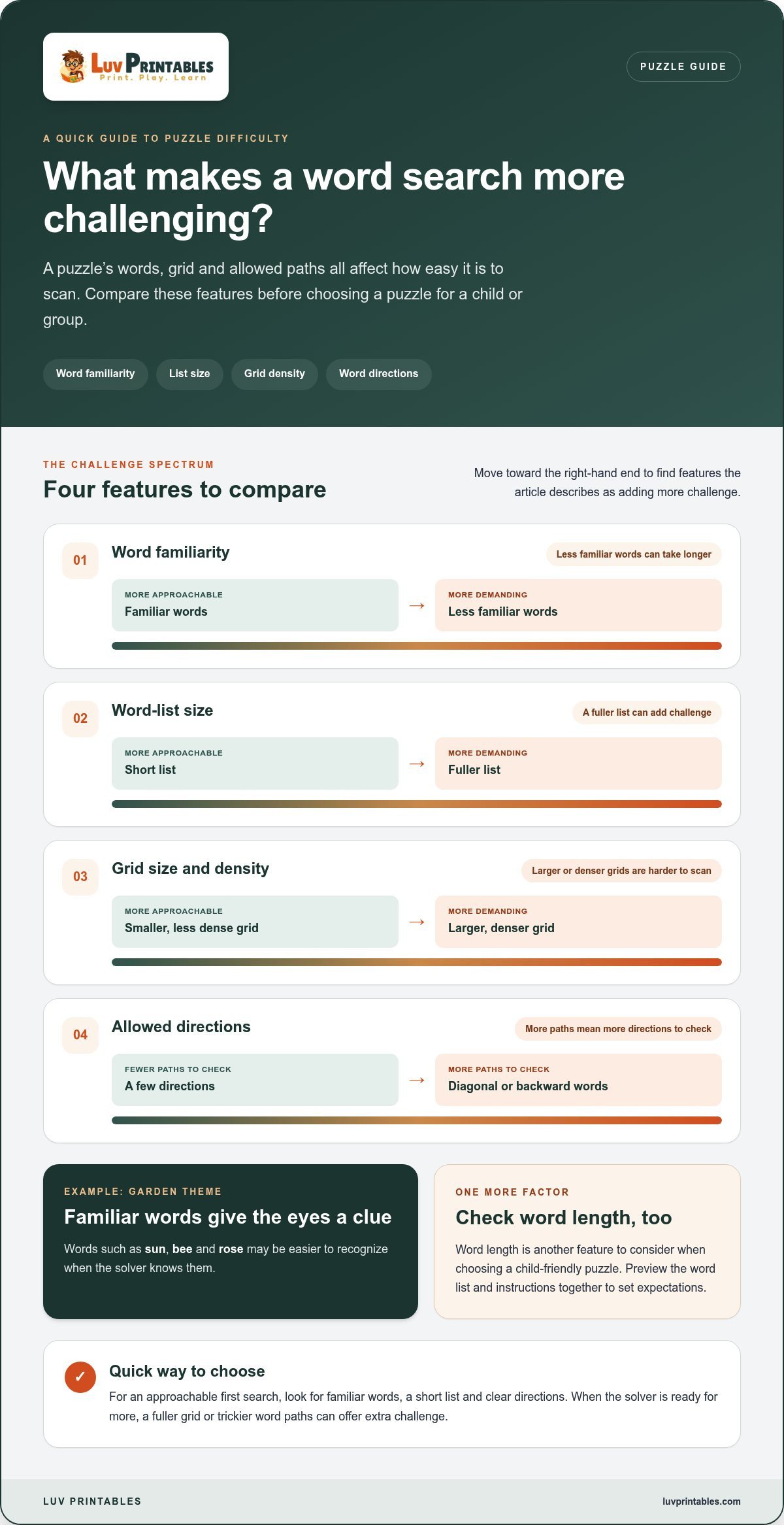
The word list, grid size, and allowed directions shape the challenge. Familiar words are easier to recognize at a glance. Unfamiliar words can take longer because the solver has to work out the spelling as well as search for the letters. A larger or denser grid can be harder to scan, while diagonal or backward words add more directions to check.
For example, imagine a garden-themed puzzle with words such as “sun,” “bee,” and “rose.” A solver who knows those words may spot their letter patterns quickly. A longer list, less familiar vocabulary, or more possible directions can require extra patience. These features don’t make a puzzle automatically better or worse. The right mix depends on the solver and the moment.
Think of each puzzle as a set of choices, not a test. A short list and clear directions can make a first search approachable. A fuller grid or trickier word paths can offer more of a challenge when the solver is ready. Preview the list and instructions together to set expectations before beginning.
How to Solve Word Search Puzzles Without Making Them Frustrating
A steady routine helps a puzzle feel like a playful search, not a test. The same approach works on paper or a screen: focus on one word at a time, mark each find, and leave the rest for later. There’s no need to race. If a child gets stuck, a pause or a gentle hint can keep the activity enjoyable while they build confidence.
A Simple Step-by-Step Way to Find Each Word
Start with the word list and choose a short word or one with a distinctive letter pattern. A word with an unusual starting letter may be easier to spot than one with several repeating letters. Keep the puzzle directions nearby so you know which paths are possible.
- Pick one word. Read it carefully and notice its first letter and any standout features, such as matching letters or an unusual combination.
- Scan for its first letter. Move across a row, then down a column, looking for places where the word could begin. Focus on one part of the grid at a time.
- Follow a likely path. From a matching first letter, trace neighboring spaces in the directions allowed by the puzzle. Check each letter in order rather than guessing from the word’s general shape.
- Mark and cross it off. Circle or highlight every letter in the complete word, then remove it from the list. On a screen, use the puzzle’s marking feature if one is available.
Marking the word prevents you from searching the same path again, and crossing it off shows what remains. For a child still learning to track letters, point to each letter in sequence as you say the word together. Offer help, then give the solver a chance to take the next turn.
What to Do When a Word Is Hard to Find
Instead of searching the same places faster, take a moment to reset. Look away from the grid, reread the word, and choose one distinctive letter to search for. If the word contains a double letter, for example, scan for that pair in neighboring spaces. A specific clue gives your eyes a fresh place to start.
- Check the directions before searching diagonally or looking for words backwards.
- Scan the grid in a new order, such as one row at a time instead of jumping between sections.
- Leave the word for later if it still won’t appear. Find another entry, then return with fresh eyes.
In a group, take turns choosing a word or spotting its first letter. One person can scan while another follows the letters, making the activity collaborative rather than competitive. A prompt such as “Which letter should we look for next?” offers support without giving away the answer.
For a ready-to-use screen-free activity, Word Sleuth Fun is a printable option for home or classroom puzzle time. Set it beside a pencil and invite the solver to choose a word to find.
Printable or Online Word Search Puzzles: Which Fits Your Situation?
The best format depends on what’s available and the kind of activity you want. Online play is convenient when a device is already open and interactive features appeal to the solver. A printable provides a screen-free page for the kitchen table, classroom desk, or another spot where a pencil is ready. Neither format is right for every situation. Choose the one that makes it easiest for your child or group to get started.
| What to consider | Online puzzle | Printable puzzle |
|---|---|---|
| Setup | Open a puzzle on an available device; internet access may be needed. | Get a printable file and use your own printer and setup to make a paper copy. |
| Screen use | Uses a screen throughout play. | Offers a screen-free activity once the page is printed. |
| Portability | Convenient wherever you have a suitable device. | A printed page is easy to carry or place on a desk. |
| Adult participation | An adult can help navigate controls or search together. | An adult can point to words, share a pencil, or let the child work independently. |
When an Online Word Search Makes Sense
Choose online play when a phone, tablet, or computer is already part of the activity and you want to begin without preparing a paper copy. Some puzzle sites include controls for selecting letters or moving to another puzzle. Features vary by site, so consider whether they suit the solver. Screen-based play may not fit a screen-free break, a classroom routine, or a child who finds device navigation distracting.
When a Printable Word Search Is a Better Fit
A printable works well when you want a screen-free page for home or class. Once printed, the word list and grid are together on paper, ready to place beside a pencil. Printing depends on having access to your own printer and setup, so plan ahead if you need to arrange those. Luv Printables offers instant-download activities designed for home and classroom use, including printable word search activities.
For a quick decision, ask yourself: Is a device already available? Do you want an interactive screen activity or a screen-free one? Is printing convenient today? The answers may change from one day to the next. A class might use an online puzzle during a device-based activity, while a printed page may fit a quiet transition or table task. Pick the format that suits the setting. An adult can join in, offer a prompt, or leave room for independent searching.
How to Choose a Word Search Puzzle for a Child or Group
Start with the solver, not a difficulty label. A puzzle about a favorite topic can feel inviting, while unfamiliar words may make even a small grid harder to approach. Before printing, preview the word list and grid. Check the words’ length, how many there are, how densely the letters fill the grid, and which directions are allowed. These details give you a clearer picture of the challenge than an “easy” or “hard” label alone.
Match the Theme and Word List to the Moment
Choose a subject the child enjoys or is curious about. Animals, food, or space can offer familiar starting points, but let the solver’s interests guide you. Then scan the list. Are the words recognizable? Are they comfortable to read, or do several have spellings the child may find tricky? A familiar theme can make it easier to begin, but it doesn’t guarantee that every word will be simple to find.
For a group, choose a topic that gives everyone something to connect with. A shared theme can help bring people into the activity, even if participants search at different speeds. Make room for different approaches: one child might work independently, while another enjoys taking turns or talking through a clue.
Adjust the Challenge Without Adding Pressure
Look at the whole puzzle before printing. A large grid, a long word list, dense letter placement, and words hidden in several directions can each add to the challenge. If the puzzle seems too demanding, try a smaller grid or more familiar vocabulary. You don’t need to change everything at once. One adjustment may make the activity more approachable.
- Word length: Notice whether the list has mostly short words or several longer ones.
- List size: Consider how many words the solver will need to track.
- Grid density: Check how much space the letter grid takes up and how easy it looks to scan.
- Directions: Read the instructions to see whether words run across, down, diagonally, or backwards.
After the first few words, notice how the solver responds. Are they settling into the search, asking for help, or losing interest? Use that as a guide. Offer a clue, suggest a pause, or let the child work at their own pace. In a group, quick finders can share a gentle hint rather than call out answers.
If a printable option suits your home or classroom, Word Sleuth Fun printable activities can bring a word search to the table. Choose a puzzle that feels inviting, then let curiosity set the pace.
Make Printable Word Search Puzzles Easy to Start at Home or in Class
A screen-free puzzle moment doesn’t need a big plan. A little preparation can make the activity feel calm and ready, whether you’re filling a quiet pocket at home or easing into a classroom transition. Choose a puzzle that suits the solver, set out the page and a pencil, and keep the invitation light. The goal is an enjoyable activity, not a perfect finish.
A Quick Setup for a Screen-Free Puzzle Moment
Before printing, look over the theme, word list, and directions. This helps you understand what the solver will see and prepare to explain how to mark each found word. Use your own printer and setup, then put the printed page and a pencil within easy reach. A comfortable place to look and mark is all you need.
Try this simple print-and-start checklist:
- Preview the puzzle. Check that the theme and words suit the moment.
- Print the page. Use the settings and materials that work with your own printer.
- Set out the essentials. Put the puzzle and a pencil where the child can reach them.
- Explain the marking. Show how to circle or highlight a found word and cross it off the list.
Then let the activity find its own rhythm. Take turns solving together, offer the page for independent learning with printable activities, or work on a few words and pause. At home, a puzzle can provide a change of pace during a quiet moment. In class, it can give students a focused option during a transition without requiring everyone to finish at once. Keep the word list visible and let each solver take the time they need.
Explore Word Sleuth Fun Printable Activities
For families and educators looking for an offline activity, Word Sleuth Fun is a Luv Printables offering in printable form. Luv Printables’ instant-download activities are designed for home and classroom use, so a printable puzzle can be part of a simple screen-free moment. After choosing an activity, use the checklist above to get your printed page and pencil ready. Solve together or independently, in one sitting or in short bursts.
If you’d like a printable option for a calm activity, explore Word Sleuth Fun. A page, a pencil, and a little space to focus are enough to get started with word search puzzles.
Make Room for a Little Word-Finding Fun
Let the next puzzle be a small invitation to pause, explore, and enjoy a shared moment. A child might choose the theme, a caregiver might join for a few minutes, or a group might fit in a search between activities. There’s no need to turn puzzle time into a lesson or finish every word. Curiosity and a comfortable pace are enough.
Luv Printables offers instant-download printable activities designed for home and classroom use. Word Sleuth Fun is one option for bringing word search play to a quiet moment. A few letters can make space for a simple screen-free activity and a shared moment of discovery.
Start small, enjoy the search, and celebrate each word you find together. Explore Word Sleuth Fun printable activities and choose a printable for your next word search puzzle.
Frequently Asked Questions
What Is a Word Search Puzzle?
A word search puzzle is a letter grid with a list of words to find. The words may appear in different directions, and each puzzle sets its own rules, so read the instructions before searching. Word search puzzles can be played online or completed on paper. For a first try, choose one word from the list and trace its letters through the grid instead of scanning randomly.
How Do You Solve a Word Search Puzzle?
Review the word list first, then choose one entry and look for a distinctive letter, such as a double letter or an unusual starting letter. Follow likely directions from that letter, checking the puzzle’s rules before searching diagonally or backwards. Mark the full word when you find it and remove it from your list. If it stays hidden, move on and return later. There’s no need to race.
Can You Print Word Search Puzzles to Solve Offline?
Yes. Some puzzle sites and printable resources offer pages you can print, while others are designed for online play. Use the print option provided for that particular puzzle and choose settings that work with your own printer. A paper copy can go on a kitchen table, in a waiting area, or on a classroom desk for screen-free play. Keep the original file if you’d like to print another copy later.
Are Printable or Online Word Search Puzzles Better for Kids?
Neither format is best for every child or situation. Online play can be handy if a device is available and the child enjoys interacting with a screen. A printable suits moments when you’d rather set out paper and a pencil. Consider the setting, available materials, and the child’s preference. For example, one format may suit a device-based classroom activity while another fits a screen-free break at home.
How Do I Choose a Word Search Puzzle for a Child?
Begin with a theme the child recognizes or wants to explore, then look closely at the puzzle. Check whether the words are familiar, how long they are, how many appear, how large the grid looks, and which directions are allowed. Difficulty labels can mean different things across puzzles. Start with an option that seems approachable, notice whether the child stays engaged, and adjust the next choice without treating it as a test.
What Should I Do If a Word Is Too Hard to Find?
Invite the solver to look for one distinctive letter in the word, then check the directions permitted by the puzzle. If the search feels stuck, pause or offer a gentle clue, such as pointing to a row that might contain the first letter. Scan together, skip that word for now, and return later. Keep the focus on exploring, not finishing quickly.