

25 Screen-Free Activities for Kids at Home: Fun & Educational Ideas

Finding simple and meaningful screen-free activities for kids can feel surprisingly hard, especially on the days when everyone is tired, the weather is bad, or your child keeps asking for a tablet. The good news is that screen-free time does not have to be complicated, expensive, or perfectly planned.
Sometimes, the best activities are the simple ones: coloring pages, printable worksheets, scissors and glue, a small basket of crayons, or a quiet table activity that gives your child something fun to focus on.
In this guide, you will find 25 easy screen-free activities for kids that are simple to set up at home. These ideas are especially helpful for parents, teachers, and homeschoolers who want children to stay busy, creative, and learning without relying on screens.
Why Screen-Free Activities Matter for Kids
Screen-free activities give children a chance to slow down and use their hands, imagination, and problem-solving skills. While screens can be useful in moderation, kids also need real-world activities that help them create, move, think, and explore.
Hands-on activities like coloring, tracing, cutting, matching, sorting, building, and pretend play can support fine motor skills, early literacy, attention span, creativity, and confidence.
Another benefit is that screen-free activities can make the day feel calmer. A simple printable worksheet or coloring page can turn a restless moment into a focused activity, especially when children know what to do and have the materials ready.
You do not need a perfect playroom or expensive supplies. A few printed pages, crayons, pencils, scissors, glue, and a small table are often enough.
25 Screen-Free Activities for Kids at Home
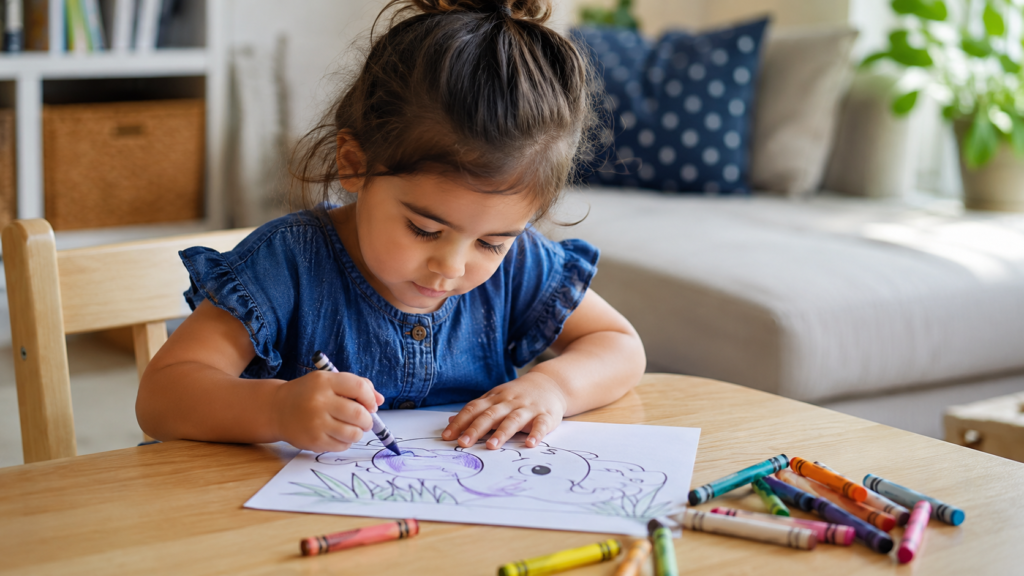
1. Printable Coloring Pages
Coloring is one of the easiest screen-free activities for kids because it works for many ages and does not need much preparation. Children can color animals, dinosaurs, space scenes, ocean creatures, seasonal pictures, or simple everyday objects.
Coloring also helps children practice hand control, patience, color recognition, and creativity. For younger kids, use simple designs with large spaces. For older kids, choose more detailed pages that keep them focused for longer.
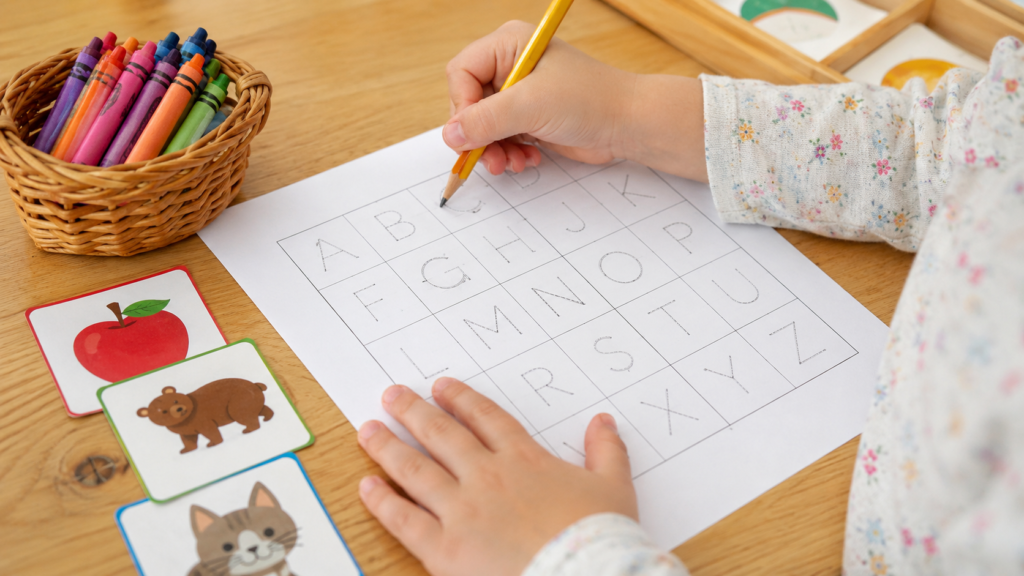
2. Alphabet Tracing Worksheets
Alphabet tracing worksheets are great for preschool and kindergarten children who are learning letters. Kids can trace uppercase and lowercase letters, say the letter sound, and color a picture that starts with that letter.
This kind of activity supports early writing, letter recognition, and pencil control. To make it more fun, let your child use different colored pencils or markers for each letter.
A printable alphabet pack can make this easier because you can keep letter practice organized and ready whenever your child needs a short learning activity.
3. Cut-and-Paste Activities
Cut-and-paste activities are simple, hands-on, and very useful for fine motor development. Children can cut out shapes, animals, letters, numbers, or pictures and glue them into the correct place.
These activities help with hand strength, coordination, focus, and following directions. They are also more engaging than regular worksheets because kids get to physically move and place the pieces.
4. Matching Games
Printable matching games are easy to prepare and can be used in many ways. Kids can match uppercase letters to lowercase letters, numbers to quantities, animals to shadows, colors to objects, or words to pictures.
Matching activities build memory, visual discrimination, and early thinking skills. You can laminate the cards or place them in a folder if you want to reuse them.
5. Indoor Scavenger Hunt
An indoor scavenger hunt is perfect when kids have energy but you cannot go outside. Ask your child to find something red, something soft, something round, something that starts with a certain letter, or something they use every morning.
You can also make a simple printable checklist and let your child mark each item as they find it. This turns a normal home environment into a fun learning game.
6. Build with Blocks or LEGO
Blocks and building toys are excellent for creativity and problem-solving. Give your child a simple challenge, such as building a tower, a bridge, a zoo, a house, or a tiny city.
For older kids, you can make it more interesting by asking them to build something that can hold a toy, stand for ten seconds, or include a certain number of pieces.
7. Printable Mazes
Mazes are great screen-free activities because they help children practice focus, pencil control, and logical thinking. Younger children can start with very simple mazes, while older kids may enjoy more detailed ones.
Mazes are also helpful for quiet time, travel, waiting rooms, or after-school routines when you need something simple but engaging.
8. Sight Word Practice
For early readers, sight word activities can make reading practice more enjoyable. Instead of only reading words from a list, kids can trace sight words, color them, match them, find them in a word search, or use them in simple sentences.
This is especially helpful for kindergarten and first-grade children who are building reading confidence.
9. Play-Dough Learning
Play-dough is more than just a fun sensory activity. Kids can use it to form letters, numbers, animals, shapes, food, or simple objects.
Ask your child to make the first letter of their name, build a number, create a small animal, or roll small balls to count. This strengthens the hands and fingers, which supports future writing skills.
10. Storytelling with Picture Cards
Picture cards can turn into a creative storytelling activity. Choose three or four cards and ask your child what happens first, what happens next, and how the story ends.
This activity builds language skills, sequencing, imagination, and confidence. It is also a nice way to encourage children to speak in full sentences.
11. Sort by Color, Shape, or Size
Sorting activities are simple and educational. Children can sort crayons, blocks, buttons, toy animals, socks, pom-poms, or printable cards by color, shape, size, or category.
Sorting is an early math skill, but it feels like play when you use real objects around the house.
12. Printable Number Activities
Number activities help children practice counting, number recognition, tracing, and simple math. For young children, keep it playful by using pictures, stickers, or real objects.
For example, your child can count five crayons, trace the number five, and then color five stars. This makes the number more meaningful than just writing it on paper.
13. DIY Puzzle Time
You can create a simple puzzle at home by printing or drawing a picture, gluing it onto thicker paper, and cutting it into pieces. Your child can color the picture first and then put the puzzle together.
This activity supports problem-solving, patience, and visual thinking. Start with large puzzle pieces for younger kids and smaller pieces for older children.
14. Quiet Reading Basket
Create a small basket with picture books, easy readers, printable mini-books, and story cards. Keep it in a cozy corner where your child can sit and look through books independently.
This is a helpful screen-free option before bedtime, after lunch, or during calm-down time.
15. Drawing Prompts
Sometimes children want to draw, but do not know where to start. Simple prompts can help. Ask them to draw a dream treehouse, a silly monster, their favorite animal, a magical garden, or a planet made of candy.
Drawing prompts encourage creativity and independent thinking. They also permit kids to be imaginative without worrying about making something perfect.
16. Simple Science Experiments
You can do easy science activities at home with simple materials. Try floating and sinking objects in a bowl of water, mixing colors, growing seeds in a cup, or watching ice melt.
These activities help children observe, ask questions, make predictions, and learn through experience.
17. Pretend Play
Pretend play is one of the most valuable screen-free activities for kids. Children can play restaurant, doctor, teacher, grocery store, post office, animal rescue, or classroom.
You can make pretend play more fun with printable menus, pretend money, signs, appointment cards, or simple role-play props.
18. Sticker Activities
Stickers are simple, low-mess, and exciting for young children. Kids can use stickers to complete patterns, decorate pages, count objects, or create little scenes.
Sticker activities also support fine motor control because children need to peel and place the stickers carefully.
19. Pattern Practice
Patterns are an important early math skill. Use crayons, blocks, beads, stickers, or printable worksheets to create simple patterns like red-blue-red-blue or circle-square-circle-square.
Ask your child what comes next in the pattern. This builds reasoning and prediction skills in a playful way.
20. Memory Card Game
Print two copies of picture cards, cut them out, and place them face down. Children take turns flipping two cards to find a match.
This activity builds memory, attention, patience, and turn-taking skills. You can use animals, letters, numbers, shapes, or seasonal images.
21. Letter Hunt Around the House
Choose one letter and ask your child to find objects that begin with that letter. For example, for the letter C, they might find a cup, car, crayon, or cushion.
This is a fun way to practice letter sounds without sitting at a desk.
22. Printable I Spy Pages
I Spy printables are great for visual attention and counting practice. Children search for objects, count how many they find, and sometimes color them as they go.
These pages are especially useful when you need a quiet but engaging activity that does not require much supervision.
23. Nature Journal
Give your child a notebook or printable nature journal page. Ask them to draw leaves, flowers, insects, clouds, birds, or anything they notice outside.
This activity encourages observation, curiosity, drawing, and early writing. It can be done in the backyard, at a park, or even by looking out the window.
24. Chore Chart or Routine Chart
A printable routine chart can help kids feel more independent. You can include simple tasks like brushing teeth, getting dressed, cleaning up toys, reading a book, or packing a school bag.
Children often enjoy checking off tasks, and parents get a smoother routine with fewer reminders.
25. Create a Printable Activity Folder
One of the easiest ways to reduce screen time is to prepare a folder filled with printable activities. Include coloring pages, tracing worksheets, mazes, matching games, number pages, and simple crafts.
When your child says, “I’m bored,” you can offer the folder and let them choose an activity. This gives them independence while keeping the options screen-free.
How to Make Screen-Free Time Easier
The secret to successful screen-free time is preparation. Children are more likely to enjoy offline activities when the materials are easy to find, and the activity feels simple to start.
- Keep crayons, pencils, glue, and scissors in one small basket.
- Print a few activities in advance.
- Offer two choices instead of asking an open-ended question.
- Start with short activities, especially for younger children.
- Praise effort instead of perfection.
For example, instead of saying, “What do you want to do?” try saying, “Would you like to color a dinosaur page or do a letter tracing activity?” This makes the decision easier and helps your child get started faster.
Best Screen-Free Activities by Age
For Toddlers
Toddlers usually enjoy simple, sensory, and colorful activities. Good options include large coloring pages, sticker play, sorting toys, play dough, simple puzzles, and matching pictures.
At this age, the goal is not perfection. The goal is exploration, movement, and hands-on learning.
For Preschoolers
Preschoolers are ready for alphabet activities, number tracing, cut-and-paste pages, color sorting, mazes, I Spy pages, and pretend play.
They often enjoy activities that feel like “big kid work,” especially when the pages are colorful and easy to complete.
For Kindergarten Kids
Kindergarten children can benefit from sight word practice, letter writing, early math worksheets, storytelling cards, pattern activities, and printable learning games.
This is a great age to mix fun with skill-building, especially for reading and early math.
For Early Elementary Kids
Older children may enjoy word searches, logic puzzles, creative writing prompts, advanced coloring pages, science journals, and independent activity folders.
They may also like themed activity packs based on animals, space, dinosaurs, seasons, or holidays.
Printable Activities Make Screen-Free Time Easier
Printable activities are one of the easiest ways to create meaningful screen-free time at home. They are affordable, simple to prepare, and flexible for different ages and learning levels.
You can print only what you need, reuse pages with sheet protectors and dry-erase markers, or create themed activity folders for different days of the week.
At Luv Printables, we create printable learning activities, coloring pages, worksheets, and educational bundles designed to help parents and teachers keep kids engaged in fun, screen-free learning.
Whether your child is learning letters, practicing sight words, coloring, counting, or simply looking for something fun to do, printable activities can make the day smoother and more productive.
Final Thoughts
Screen-free activities for kids do not need to be complicated. The best activities are often simple, hands-on, and easy to repeat. Coloring, tracing, matching, building, cutting, sorting, reading, and pretend play can all help children learn while having fun.
Start with just a few ideas from this list and keep a small printable activity folder ready at home. Over time, your child may begin reaching for creative, hands-on activities more naturally.
Ready to make screen-free time easier? Explore Luv Printables for printable worksheets, coloring pages, learning activities, and ready-to-use activity packs for kids.